
I-35 Capitol Express utility relocation
TxDOT widening relocates water, electric, and telecom under main lanes and frontage roads. HDD reduces closure footprint — MOT and night windows part of permit scope.
Austin, TX · Travis County
River, highway, and railroad crossings in Austin — Barton Creek, Onion Creek, I-35, MoPac, and CAPMetro Red Line with TxDOT Austin District permits planned months ahead.
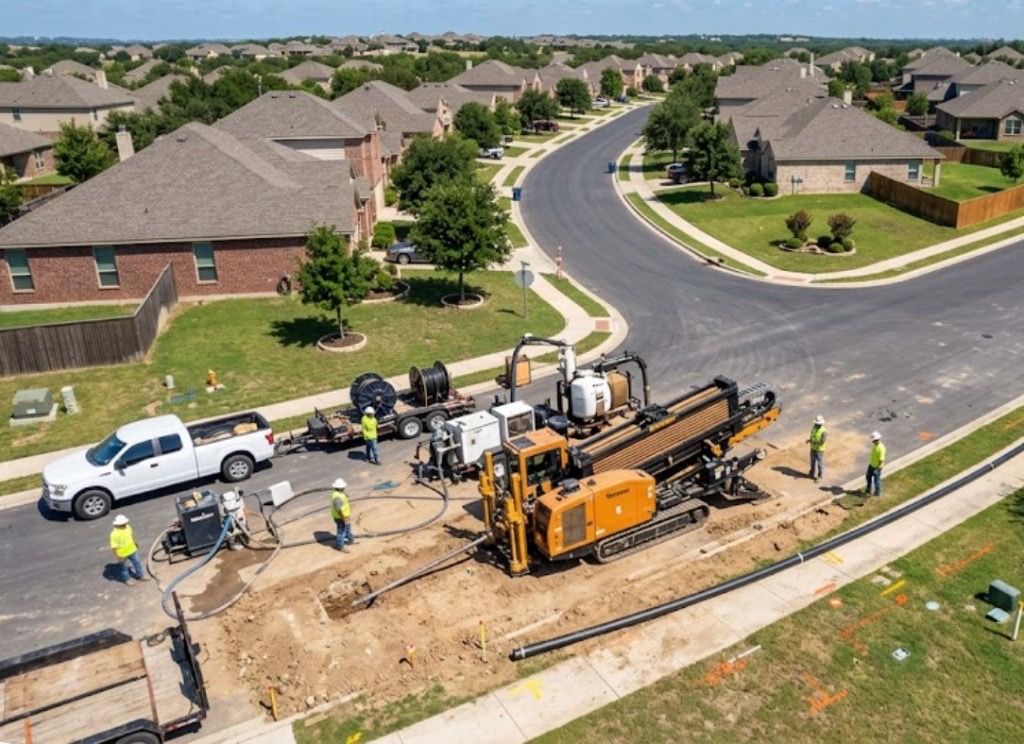
River, highway, and railroad crossing bores in Austin meet TxDOT Austin District, CAPMetro engineering, and creek floodplain rules on Barton, Onion, and Waller corridors. Engineered scopes — MOT, casing spec, and agency windows often take longer than the physical bore.
Directional Boring Texas scopes long-span HDD and jack-and-bore crossings with profiles, traffic control, and transit flagging visible in the quote. Edwards limestone, flash-flood risk, and I-35 congestion define how Travis crossings are staged — especially when spring storms saturate creek-side entries.
Real Travis County angles — not generic statewide copy.
TxDOT widening relocates water, electric, and telecom under main lanes and frontage roads. HDD reduces closure footprint — MOT and night windows part of permit scope.
Park-adjacent utilities need easement compliance and bank protection. Entry shafts set back from slopes; mud tuned for saturated soils after storms.
Transit templates specify casing, flagging, and installation windows. Rigs mobilize after CAPMetro agreements — lead time exceeds bore duration.
Feeders cross frontage and interchanges with stacked shallow utilities. TxDOT and city MOT combine with remark-intensive locate work.
Engineered alignment and geotech guide rig class and casing. TxDOT, CAPMetro, and floodplain permits precede mobilization. Creek-adjacent drilling pauses when flash-flood soils are unsafe.
Edwards Limestone, Austin Chalk, and iron-rich clay create variable drilling response — especially west and southwest of downtown.
Travis County profiles transition from east-side clay to west-side limestone and chalk. Iron-rich clay can ball up on reamers without proper mud chemistry. Limestone intervals may require harder tooling and slower production. Near the Edwards aquifer recharge zone, fluid loss and bore stability get extra attention — not because HDD is banned, but because documentation and depth control matter to reviewers. Hill Country slopes change pullback loads and require rig positioning planning on tight residential lots.
Flash flooding in Hill Country drainages, drought-hardened soils, and summer heat shape when pits can be opened safely in Austin.
Spring storms can dump inches in hours — creek-adjacent jobs pause when pits flood. Summer drought hardens clay and can increase torque. Winter freezes are infrequent but spike pipe break calls; locates still precede emergency bores.
City of Austin Development Services, Austin Water, Travis County, CAPMetro adjacency, and TxDOT Austin District.
City of Austin permits ROW occupancy, drive cuts, and bore notifications. Austin Water reviews sewer tie-ins. Travis County governs unincorporated areas. TxDOT Austin District handles I-35, MoPac, US-183, and SH-130 crossings. CAPMetro coordination applies near rail. Tree ordinances on protected oaks may affect pit placement even when the bore itself is trenchless — we plan pits to reduce arborist conflicts.
Open-cut across I-35 or CAPMetro ROW is rarely permitted full width. Creek open trenching triggers floodplain and erosion issues — trenchless is default when agencies allow.
Length, diameter, groundwater, environmental windows, traffic control, rail flagging, engineering, and inspection.
We review plans, bore path, access, existing utilities, and owner goals — residential repair or engineered crossing.
Texas dig law compliance: ticket, wait period, verify marks, pothole at conflicts before steel or bit enters ground.
Alignment, profile, soil expectations, permit needs, and crossing agreements for roads, rails, or waterways.
Right rig for length and diameter — mini-HDD for tight urban shots, larger spreads for long pulls and reams.
Steerable pilot, survey checks, reaming passes as required for product pipe or casing diameter.
HDPE fusion, steel casing, conduit bundles, or carrier pipe installed per spec with pullback monitoring.
Alignment records, mandrel or pressure tests where spec requires, as-built for owners and inspectors.
Minimal surface disturbance philosophy — compact entry/exit pits, restore hardscape and landscape per scope.
TxDOT Austin District MOT and utility agreements often need weeks to months — start early.
Yes with easement compliance and bank stability review. Flash floods may shift schedules.
Transit engineering agreements frequently exceed field duration.
CAPMetro and railroad spec often dictates casing pushes.
Span, diameter, rock, permits, MOT, CAPMetro coordination, and casing drive price.
24/7 — Emergency dispatch statewide. Tell us your bore path, pipe size, and city — a specialist calls or texts back with a straight answer.
Free bore estimate
Step 1 of 2 — project details first