24/7 dispatch
Line failure, utility strike, or tight GC schedule — we answer when other crews clock out across Texas.
Texas statewide
Auger boring (jack and bore) pushes steel casing through soil from a drive pit to a reception pit while rotating a cutting head. Product pipe or carrier lines are often installed inside the casing. It excels at shorter, straight drives under railroads, highways, and levees where rigid casing is required.
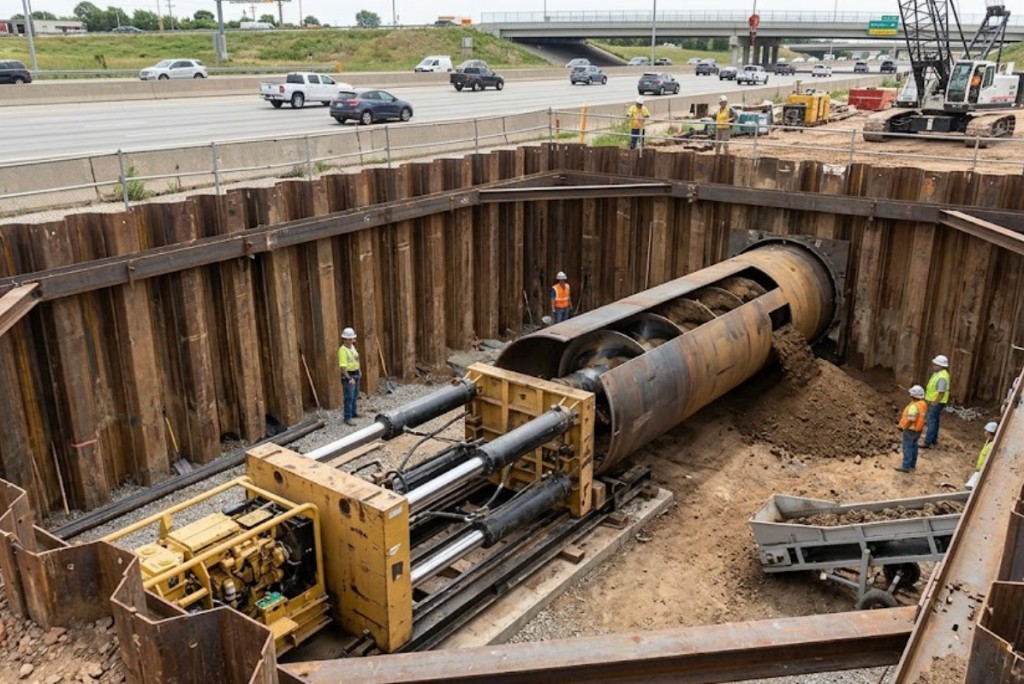
Auger boring (jack and bore) pushes steel casing through soil from a drive pit to a reception pit while rotating a cutting head. Product pipe or carrier lines are often installed inside the casing. It excels at shorter, straight drives under railroads, highways, and levees where rigid casing is required.
A jacking frame pushes the casing forward in segments while an auger removes spoil to the drive pit. Line and grade are held by pit setup and survey control. After casing is in place, carriers are installed and grouted per spec.
Steel casing from 12 inch through 72 inch and larger; internal carriers in HDPE, DIP, PVC, or multiple ducts.
Typical drives from 40 to 500 feet depending on diameter, jacking force, and soil — longer when engineered with intermediate jacking.
Jack and bore avoids stripping pavement full-width for short crossings. HDD may be better on curved alignments; auger bore wins on straight casing installs in competent soils.
Locates and pit excavation expose adjacent utilities. Shoring, dewatering, and traffic control follow city and state ROW requirements on Texas work.
Casing diameter, drive length, pit depth, soil type, shoring, dewatering, traffic control, and rail or highway permit fees.
Get a Free Estimate →Less mess, less downtime, clear answers before we mobilize.
Line failure, utility strike, or tight GC schedule — we answer when other crews clock out across Texas.
Tell us the path, pipe, and city — we explain cost drivers upfront. No flat-rate gimmicks.
Texas utility locates and potholing before steel enters the ground — protects you and your neighbors.
Small entry pits instead of trenches through driveways, landscaping, and retail parking.
Straight casing pushes often favor jack and bore; curved paths or longer spans without casing often favor HDD. We recommend after alignment and agency requirements are clear.
Yes when railroad agreements, casing spec, and locate windows align. Lead time for rail coordination is often longer than the bore itself.
Running sand, boulders, and unstable groundwater without dewatering can challenge jacking. Geotech and test pits reduce surprises.
HDD is a steerable trenchless method that drills a pilot hole underground, then reams and pulls pipe or conduit through the bore path. It avoids open trenches across roads, rivers, driveways, and finished landscaping.
Cost depends on bore length, pipe diameter, soil and rock, access, traffic control, permits, and utility congestion — not a flat per-foot rate. We provide free estimates after scope review; no fabricated prices on our site.
24/7 — Emergency dispatch statewide — (512) 838-3643
Free bore estimate
Step 1 of 2 — project details first