Casing under a rail approach near port trackage
Railroad and port agreements gate calendar months before steel moves. Jack and bore from shored pits pushes casing while flagging windows honor industrial traffic.
Corpus Christi, TX · Nueces County
Jack-and-bore casing under Corpus Christi canal levees, rail approaches, and straight industrial crossings — rigid steel where coastal agency specs demand it.
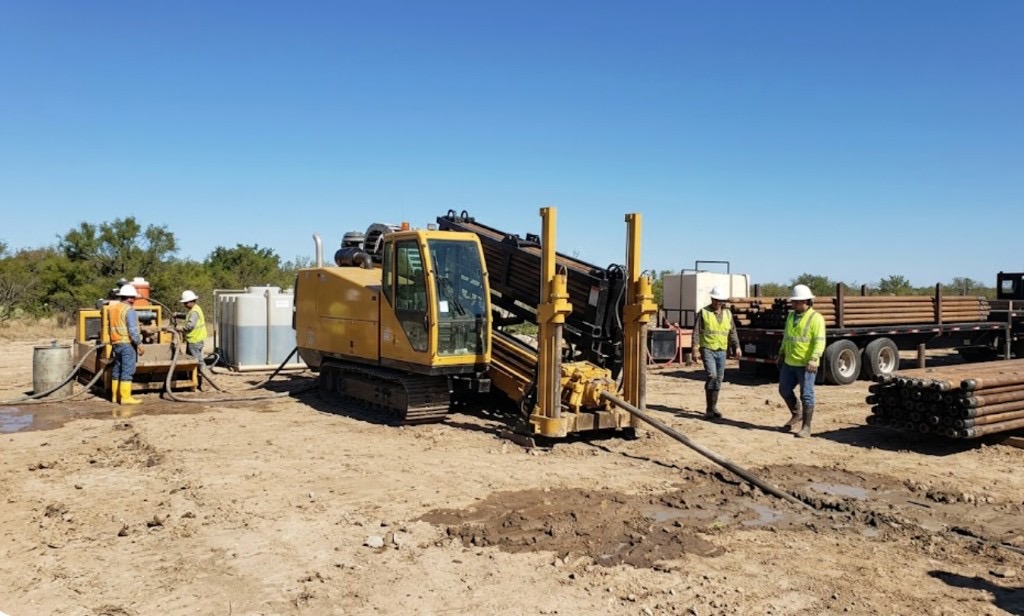
Auger boring in Corpus Christi fits straight drives where owner or agency spec requires steel casing — canal levees, rail spurs near port trackage, and warehouse loading lanes on southside industrial rows. Drive pits are shored for sand, shell hash, and high groundwater near bays.
Jack and bore holds line and grade on a fixed push — valuable when port or railroad templates require documented casing before carriers enter. Directional Boring Texas scopes jacking force, pit depth, and dewatering for Nueces alignments before quoting windows.
Real Nueces County angles — not generic statewide copy.
Railroad and port agreements gate calendar months before steel moves. Jack and bore from shored pits pushes casing while flagging windows honor industrial traffic.
Municipal storm near canal banks needs casing protecting RCP from scour in loose coastal soils. Straight auger drives avoid stripping riparian restoration open-cut would disturb.
Industrial expansions require casing under future loading lanes before concrete is placed. Compact jack pits push steel while process-road access still exists.
TxDOT approach slabs on SPID and I-37 frontage roads spec casing for certain crossings. Auger bore minimizes pavement removal in coastal wind exposure.
Shored drive and reception pits account for sand collapse and shell layers. Casing segments jack forward while spoil is removed. Survey holds line and grade; carriers grout per spec. Canal-adjacent pits pause when tropical downpours flood low entries.
Coastal sands, shell hash, and soft clays with high groundwater near bays and canals — different steering and fluid plans than inland Texas.
Nueces County coastal profiles feature loose sands, shell layers, and soft clay with high water tables near bays. Sands require careful fluid program to prevent collapse; ream stages may be shorter and more frequent. Shell hash accelerates wear. Inland Calallen and Annaville see firmer clay — still coastal-influenced groundwater. We do not use inland clay assumptions for beach-side bores.
Gulf humidity, coastal wind, hurricane evacuation routes, and salt exposure affect restoration materials and work windows in Corpus Christi.
Hurricane season elevates schedule risk June through November — owners want utilities in before peak season. Coastal wind affects lane closure setups on high bridges. Sudden tropical downpours flood low entries near canals. Salt air favors corrosion-resistant hardware on exposed pit structures.
City of Corpus Christi Engineering, Nueces County, TxDOT Corpus District, port authority adjacency, and hurricane route priorities on I-37.
City of Corpus Christi Engineering permits ROW work. Nueces County handles unincorporated areas. TxDOT Corpus District governs I-37, US-181, and SPID crossings. Port of Corpus Christi properties require owner coordination. Hurricane evacuation route work may face seasonal restrictions during peak storm preparedness windows.
Jack and bore avoids stripping full pavement on moderate straight crossings. HDD wins on curved bay alignments. Near port ROW, method follows owner template.
Casing diameter, drive length, pit depth, soil type, shoring, dewatering, traffic control, and rail or highway permit fees.
We review plans, bore path, access, existing utilities, and owner goals — residential repair or engineered crossing.
Texas dig law compliance: ticket, wait period, verify marks, pothole at conflicts before steel or bit enters ground.
Alignment, profile, soil expectations, permit needs, and crossing agreements for roads, rails, or waterways.
Right rig for length and diameter — mini-HDD for tight urban shots, larger spreads for long pulls and reams.
Steerable pilot, survey checks, reaming passes as required for product pipe or casing diameter.
HDPE fusion, steel casing, conduit bundles, or carrier pipe installed per spec with pullback monitoring.
Alignment records, mandrel or pressure tests where spec requires, as-built for owners and inspectors.
Minimal surface disturbance philosophy — compact entry/exit pits, restore hardscape and landscape per scope.
Straight casing under rail or levee templates favor jack and bore. Curved paths or long HDPE pulls favor HDD.
Yes when railroad and port agreements, casing spec, and locate windows align.
Depth follows casing diameter and shoring — loose sand and high groundwater extend pit work significantly.
Steel casing from 12 inch through 72 inch and larger on engineered bay and highway crossings.
Yes — pit excavation exposes AEP Coastal, Corpus Christi Water, gas, and telecom.
24/7 — Emergency dispatch statewide. Tell us your bore path, pipe size, and city — a specialist calls or texts back with a straight answer.
Free bore estimate
Step 1 of 2 — project details first